Looks Like a Wookie - Ili Pika


This is a real critter. Quite cute.

"This furry ball of cuteness is an endangered mammal closely related to rabbits and hares. The species was first discovered in 1983 and individuals have rarely been seen since."

"It was first spotted in the Tian Shan Mountains in China, where it makes the holes and cracks of the cliffs its home. Despite other family of pika living across theNorthern Hemisphere, these mountains are the only place this Ewok lookalike seems to feel at home."

Click to read more:

http://www.businessinsider.com/endangered-ili-pika-first-sighted-since-1983-2015-3#ixzz3V4sdd0eb

Chicago Tops Country for Company Expansions & Relocations

Chicago Tops Country for Company Expansions & Relocations for Second Year in a Row


"The winters in Chicago may be brutally cold and snowy, but according to a new report from the corporate real estate magazine Site Selection, businesses love the Windy City. According to the magazine, 385 companies either expanded their operations in or relocated to the Chicagoland area in 2014, earning the city the top spot on Site Selection's Top Metro in the US for the second year in a row."

Click to read the full article:

http://chicago.curbed.com/archives/2015/03/10/385-companies-expanded-or-moved-to-chicago-in-2014.php


Genetic pacification of Western Europeans (?)

Interesting paper.

Genetic pacification of Western Europeans (?)

Evolutionary Psychology www.epjournal.net – 2015. 13(1): 230-243

Western Europe, State Formation, and Genetic Pacification 

Peter Frost, Henry C. Harpending

Through its monopoly on violence, the State tends to pacify social relations. Such pacification proceeded slowly in Western Europe between the 5th and 11th centuries, being hindered by the rudimentary nature of law enforcement, the belief in a man’s right to settle personal disputes as he saw fit, and the Church’s opposition to the death penalty. These hindrances began to dissolve in the 11th century with a consensus by Church and State that the wicked should be punished so that the good may live in peace. Courts imposed the death penalty more and more often and, by the late Middle Ages, were condemning to death between 0.5 and 1.0% of all men of each generation, with perhaps just as many offenders dying at the scene of the crime or in prison while awaiting trial. Meanwhile, the homicide rate plummeted from the 14th century to the 20th. The pool of violent men dried up until most murders occurred under conditions of jealousy, intoxication, or extreme stress. The decline in personal violence is usually attributed to harsher punishment and the longer-term effects of cultural conditioning. It may also be, however, that this new cultural environment selected against propensities for violence.

Link (pdf)


Mass Deaths in Americas Start New CO2 Epoch

An interesting article in Scientific American proposes that the death of native Americans following European colonization of America caused massive reforestation of former farmlands, which sequestered mass amounts of carbon dioxide from the atmospher, which led to the mini ice age.


"The atmosphere recorded the mass death, slavery and war that followed 1492. The death by smallpox and warfare of an estimated 50 million native Americans—as well as the enslavement of Africans to work in the newly depopulated Americas—allowed forests to grow in former farmlands. By 1610, the growth of all those trees had sucked enough carbon dioxide out of the sky to cause a drop of at least seven parts per million in atmospheric concentrations of the most prominent greenhouse gas and start a little ice age. Based on that dramatic shift, 1610 should be considered the start date of a new, proposed geologic epoch—the Anthropocene, or recent age of humanity—according to the authors of a new study."

scientificamerican.com/article/mass-deaths-in-americas-start-new-co2-epoch/


An interesting theory which adds to a number of other theories about what caused the mini ice age and other ices ages. The Wiki articles below describe the little ice age and major ice ages.

en.wikipedia.org/wiki/Little_Ice_Age

en.wikipedia.org/wiki/Ice_age


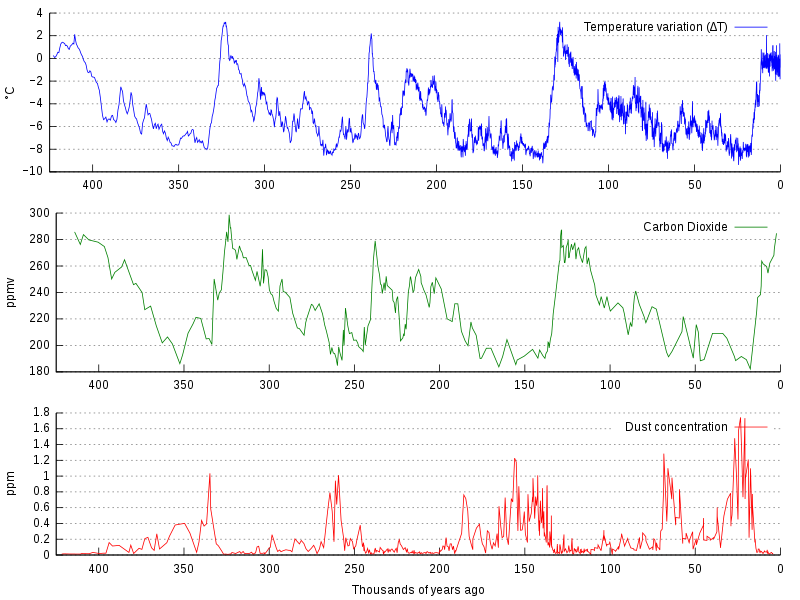
The graph below from the wiki article shows global temperatures for the past 400,000 plus years. Ice ages come and go as the graph shows. The little ice age really does not show up in this long term graph. 


Look at how the first bar - global temperature - correlates with the second graph - which is carbon dioxide. It correlates. Of course correlation does not prove causation.  And the first 390,000 plus years did not involve very many humans and no agriculture. Something else must have caused carbon dioxide levels to rise and fall.


Thanks to Taffy Cannon for sharing this article.


Richard Anderer I'd not heard this theory but find it interesting. Since the Little Ice Age was pre-Industrial Revolution I have often wondered what might have caused cooling over that period of time. With or without 'man' the earth has undergone tremendous change. However, with over 7 billion people breathing in and out (plus other functions we won't discuss) how can we not say humans are a factor in current changes?


Successful Open Space Planning

Open space planning can be a fun and interesting effort.  It is kind of a hobby of mine and I enjoy helping envision open space projects, developing a short plan, and then helping build support for the plan. My projects have failed more often than succeeded - it is not easy.

I discuss three projects below - the successful Plank Road Trail Plan and the Chaminwood Lake Plan, and the Ward Lake Plan which I just wrote a few weeks ago.

Guidelines For A Successful Open Space Project

1. Develop a simple plan - one page on the internet is best.

2. Develop a good map and graphic.

3. Come up with an attractive name.

4. Try to get land owners interested in a partial donation.

5. Develop political support.
.
6. Build coalitions.

7. Find the money.

8. Acquire and improve the park.

9. Celebrate success with photos.

10. Repeat the process with another site.


Plank Road Trail


The Plank Road Trail is a nice bikepath / trail that runs east-west across Will and Cook County south of Chicago.The conversion of the old railroad to a trail was proposed by the Northeastern Illinois Planning Commission and the Will County Forest Preserve District in their Acquisition Plan prepared in 1973-75. I worked on that plan.

The project was referred to as “The abandoned Penn Central Railroad Right of Way”, which is not exactly a great marketing name. "Abandoned Penn Central Railroad Right-of-Way," didn't have the magic to stir men's souls.

The rails were removed in 1981. Bob Sullivan AICP and I prepared the The Plank Road Trail in 1981, which gave the project a much more marketable name. The project was originally proposed as a Plank Road, which was a toll road. It was never built as a Plank Road but was changed to a railroad.

In searching for a name that supporters could like we found that the project had originally been named the "Oswego and Indiana Plank Road" name that had been proposed for the route in 1849. It was never built as a Plank Road (Toll Road with planks for pavement), but we dubbed it the Old Plank Road Trail and the name caught on.

Carl Glassford formed an action committee which worked hard and successfully to get support from the communities of Matteson, Frankfort, Park Forest, Mokena, New Lenox, Will and Cook Counties, and the State of Illinois. I can remember one evening in the Matteson Village Hall. The Council was opposed to the trail - sounded like a boondoggle to them. Carl and his committee made a presentation to the Board, and they completely changed their mind. They got it that a lineal park running through their historic downtown and connecting to their regional mall and many of their residential neighborhoods was a good thing.

The State of Illinois, the Northeastern Illinois Planning Commission, the Will and Cook County Forest Preserve commissions, and the Open Lands Commission supported the concept. They began to work to gain control of the property.

It took 17 years from the time we gave it the name of "Plank Road Trail" until you could walk on the paved path.  Public projects take a long time to bring into fruition.


The development of the trail positively enhanced the image of the southern suburbs. The trail connected the historical business districts of Frankfort and Matteson to Lincoln Mall and the Matteson ICG station. Visitors to the area can take pleasant walks through these communities.
Much more about the Trail at oprt.org


The Trail is part of the American Discovery Trail which cross the entire United States - a seriously long walk.


Click for more info:   discoverytrail.org

Rails to Trails:   railstotrails.org


This blog was created to Plan the Planet. It is a work in progress - please click here if you wish to propose changes or additions or ask q...