Build America Now


Proposal

Federal Guarantee Municipal Bonds to Stimulate the Economy

Our economy is a wreck. We need to to get back on track.

The Federal government should guarantee municipal bonds to accelerate public works construction. This would encourage local governments to improve needed roads, sewer & water, curbs and sidewalks, schools, and other important infrastructure this year when we need the stimulus.

Put America back to work. 
Build America now!

This is the year for municipalities, school districts, and other governments to build major capital projects. We need the economic stimulus and jobs. Contractor prices are low. They need work, and we need infrastructure improvements. This would be a great way to stimulate our economy.

The goal is to help communities stay vital and not slip into an irreversible decline. Schools and community infrastructure are critical to supporting home values and stemming the declines we have seen in recent years.

Most local governments have a backlog of needed public infrastructure improvements. With support and encouragement from the Federal government, we could have major local programs underway soon.

This should be a very simple and low cost way to stimulate substantial public works expenditures this year,  As economic uncertainty continues, corporations cut back on spending and jobs. This is the correct course of action for them - they have to stay solvent to survive. 

At the same time, the Federal Government cranks up spending in order to revitalize the economy. Substantial national government spending is required to stimulate the economy. Government acts in an anti cyclical fashion to get the economy growing again. And our Federal Government is spending.

State and local governments, however, often act like private corporations. They, unlike the Federal government, cannot print money. But for many reasons, this is the wrong course of action. Local governments can borrow money at cheap tax exempt rates, and build needed public improvements such as improved roads, schools, and sewer and water systems.

The Federal government should support and encourage local and State government spending. They could do this by guaranteeing bonds and using the bully pulpit of the Presidency to advocate for an aggressive program of local and State government public works expansion efforts.

Strong local governments with AA and better bond ratings have no trouble borrowing money now. But weaker rated governments do have trouble getting good rates. And local governments tend to slow capital spending during recessions. 

The country needs them to crank up capital spending substantially. A Federal guarantee would ensure good rates for all municipal and State borrowers. This would be a strong incentive for local governments to borrow and construct needed improvements now.

This stimulus effort by all levels of government is a safe and effective way to get America back to work. Local governments are good at building local public works projects that are needed and worthwhile. They usually do a good job at cost containment. And they seldom default, so the risk to the Federal government is quite low.

This program would help America regain its economic mojo at little cost or risk to the Federal Government.

Build America Now!

My Marine Corps blogs

College Degree Attainment


Some interesting info from the Urbanophile.


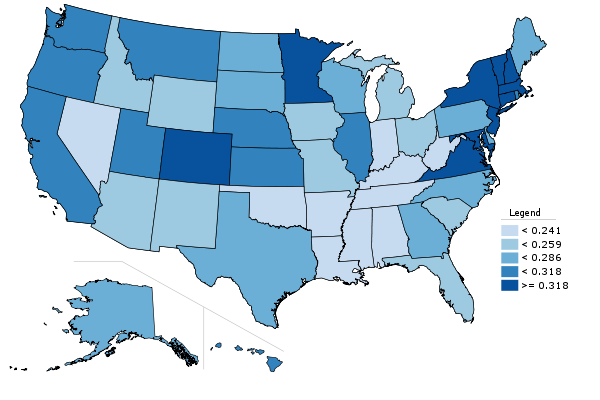
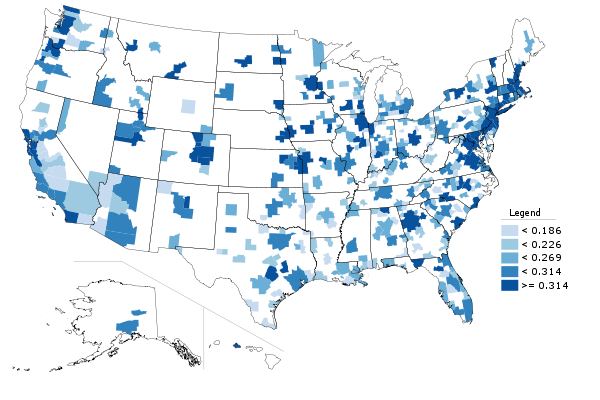
College degree attainment (the percentage of adults with a bachelors degree or higher), is one of the most critical factors in urban success. The map shows the percentage of college graduates by State. Dark blue is higher.


Here are the top ten metro areas, among those with a population greater than one million, showing total number of people with degrees and the attainment percentage:


RowMetro Area2010
1Washington-Arlington-Alexandria, DC-VA-MD-WV1,758,297 (46.8%)
2San Jose-Sunnyvale-Santa Clara, CA558,519 (45.3%)
3San Francisco-Oakland-Fremont, CA1,317,354 (43.4%)
4Boston-Cambridge-Quincy, MA-NH1,335,276 (43.0%)
5Raleigh-Cary, NC301,012 (41.0%)
6Austin-Round Rock-San Marcos, TX429,163 (39.4%)
7Denver-Aurora-Broomfield, CO651,661 (38.2%)
8Minneapolis-St. Paul-Bloomington, MN-WI822,321 (37.9%)
9Seattle-Tacoma-Bellevue, WA867,193 (37.0%)
10New York-Northern New Jersey-Long Island, NY-NJ-PA4,613,445 (36.0%)

And here’s the bottom ten:

RowMetro Area2010
1Riverside-San Bernardino-Ontario, CA499,663 (19.5%)
2Las Vegas-Paradise, NV278,387 (21.6%)
3Memphis, TN-MS-AR209,987 (25.1%)
4San Antonio-New Braunfels, TX344,247 (25.4%)
5Louisville/Jefferson County, KY-IN224,392 (25.8%)
6Tampa-St. Petersburg-Clearwater, FL513,182 (26.2%)
7Birmingham-Hoover, AL198,856 (26.3%)
8New Orleans-Metairie-Kenner, LA209,916 (26.8%)
9Jacksonville, FL241,801 (26.9%)
10Phoenix-Mesa-Glendale, AZ731,643 (27.2%)


Read the full article at:


Read the full article at:


Burning Man - Urban Planning


A Vision of How People Should Live, From Desert Revelers to Urbanites

Courtesy of GeoEye
A 2006 image of the grounds at the Burning Man festival, called Black Rock City, in Nevada.
GERLACH, Nev. — How many city planners get to see their ideas take shape all around them?


Rod Garrett 


Heidi Schumann for The New York Times


Burning Man in 2006. The annual festival that began in 1986 with about 20 people is expected to draw 50,000 this year.


The short list includes Georges-Eugène Haussmann, who bulldozed much of Paris in the mid-19th century, and Robert Moses, who remade New York during the 20th.
And Rod Garrett, who, beginning in 1997, laid out Burning Man, the annual festival of self-expression in the parched northern Nevada desert.
Mr. Garrett died last week at 74, just short of the 25th anniversary of Burning Man’s founding.

The Pinta and Nina Visit Peoria


Pinta and the Nina Visit Peoria


Discover Columbus' Ships 

Welcome to The Columbus Foundation and our two Columbus replica ships - our original Niña, the most historically accurate replica of a Columbus Ship ever built, and our recently-built Pinta. 


Deck length - 65', Beam - 18', Draft - 7'
Tonnage - 75, Sail Area - 1919 sq ft

Deck length - 85', Beam - 23', Draft - 7.5'
Tonnage - 101, Sail Area - 3800 sq ft


The Niña - Most Historically Accurate Columbus Replica Ship Ever Built 
The Niña is a replica of the ship on which Columbus sailed across the Atlantic on his three voyages of discovery to the new world beginning in 1492.  Columbus sailed the tiny ship over 25,000 miles.  That ship was last heard of in 1501, but the new Niña has a different mission.  We are a floating museum, and we visit ports all over the Western Hemisphere.

Pinta - Our Second Columbus Replica Ship 
Pinta was recently built in Brazil to accompany the Nina on all of her travels. She is a larger version of the archetypal caravel and offers larger deck space for walk-aboard tours and has a 40 ft air conditioned main cabin down below with seating. Pinta is available for private parties and charters. 

NEW!  The City of Dubuque, Iowa, produced a great video of The Niña and Pinta, featuring an informative interview with Captain Morgan Sanger.   CLICK HERE to view the movie.

The Niña and Pinta
Both The Niña and Pinta will be touring together as a new and enhanced ‘sailing museum’, for the purpose of educating the public and school children on the ‘caravel’, a Portuguese ship used by Columbus and many early explorers to discover the world.
The Niña and Pinta

The Niña and Pinta

 BUILDING THE NIÑA BUILDING PINTA
 MISS ELLIE & THE NIÑA THE ORIGINAL NIÑA
 3 REASONS TO VISIT DOCKSIDE CHARTERS
 GIFT SHOP PHOTO ALBUM
 SCHEDULE INFORMACIÓN EN ESPAÑOL
 HOME E-MAIL US

Interested in becoming a CREW MEMBER?  Click here.

The Columbus Foundation, British Virgin Islands
Phone: (284) 495-4618    Fax: (284) 495-9935 

City View Urban Capital Fund


  • CityView project

    CityView project
    West 27th Place in Los Angeles. Courtesy of CityView/symphony development
New Urban News
CityView, based in Los Angeles and founded by former HUD secretary Henry Cisneros, is a capital fund that invests in urban real estate, with $2 billion in urban investments in 45 communities in 13 states as of August 2011. A recent example is West 27th Place, a seven-story building that hugs the corner of West 27th and Figueroa streets in Los Angeles, a neighborhood with a Walk Score of 95, within a short walk from multiple transit stops.

Economic Development Incentives


Summary of Economic Development Incentive Programs in Illinois


The following information is a cursory view of Economic Development Incentives that are available to municipalities in the State of Illinois. All incentives are, foremost, at the discretion of the municipality. Municipalities should have policies in place that describe when and under what circumstances they will award incentives. Incentives should always be granted for the public good and should only be granted to make the project work. Communities should assure that, “but for” the incentive the project is not financially possible. Many times this will mean that the community reviews the pro forma of the developer to determine the level of the incentive. The community should evaluate the amount of the incentive in proportion to the financial risk of the developer.

Tax Increment Financing—65ILCS, 5/11-74.4.1 et.seq.


TIF is perhaps the best-known incentive available to communities in Illinois. When a community institutes a TIF district it freezes the existing Equalized Assessed Valuation for all taxing districts for the next twenty-three years or until the TIF dissolved. Any increase in the EAV and its resulting property tax are applied toward development of the district.

Communities can use the increment to support a myriad of economic development activities; the most common is for the development of infrastructure. In addition, TIF can write down the purchase of the land, pay for preparation of the land (including grading for drainage and demolition), and pay for the following and other costs: partial interest costs, rehabilitiaion and lease hold improvement costs, relocation costs, and landscaping, etc.

Business District—65-ILCS 5/11-74.3-1

A Business District can be established for a particular site or series of parcels. The municipality then implements an additional sales or hotel motel tax to a maximum of 1%. The proceeds from this new sales tax are applied to costs of the development of the site. Eligible costs are similar to that of TIF.

Sales Tax Revenue Sharing

Municipalities may enter into agreement to share or rebate any portion of any retailer’s occupation tax that is generated by the development for a finite period of years. The municipality must make findings related to the property and in general the abatement should serve a public purpose as creating development in adjacent areas or creating or retaining jobs, enhancing the tax base of the municipality.

Property Tax Abatement--35ILCS 200/18-165

The community can provide a maximum of $4 million dollars in tax property tax abatement within a ten-year period for commercial and industrial development. The municipality may be joined by other taxing bodies in providing this abatement. Normally there is an agreement based on all or part of the property taxes being rebated over a number of years.

Special Services Area or Special Assessment

An area is created where a special assessment is placed against property to finance certain public improvements or services. This incentive has become popular in recent years to incent the development of housing. In this case the developer requests that public infrastructure (in the past, mostly financed by the developer) be financed by the community. The community publicly finances this infrastructure at a tax-exempt rate and applies an assessment to the property. These bonds incent development by removing the costs of infrastructure.


Enterprise Zones

The Illinois Enterprise Zone Act creates a specific area jointly designated by the State and local government that allows various tax incentives and other benefits to stimulate economic activity and neighborhood revitalization.

The following are among the incentives that are available in an enterprise zone: Investment Tax Credit, construction material sales tax deduction, machinery and equipment sales tax exemption, utility tax exemption, jobs tax credit, tax abatement income tax deduction for financial institutions on loans for development in enterprise zone, corporate contribution deduction.

Revolving Loan Fund

The municipality subsidizes private loans through a revolving loan fund.

General Municipal Assistance

The municipality may provide a number of incentives for economic development in the general course of doing business. They may reduce or eliminate fees that apply toward development. They may work with the developer to minimize the time taken to process development.

State Incentives


Both the State and Urban Counties provide for Community Development Block Grant Funds or the CDAP program for the State. (See the Department of Commerce and Community Affairs Web site)

The Department of Commerce and Economic Opportunity administers the EDGE Tax to reduce the cost of doing business in Illinois when compared with similar costs in other states allowing for tax credits.

The Environmental Protection State has a Brownfield clean up program that offers a variety of incentives.

The Illinois Department of Transportation is administers funds for roads to support economic development.

The Illinois Development Finance Authority provides Industrial Revenue Bonds.

The State of Illinois Web site provides access to all departments and their programs.

Typical Low Interest Loan Programs

Industrial Revenue Bonds

Very large loans (must be greater that $1.5M) for significant manufacturing and industrial projects, used to acquire fixed assets. Can be issued by the City of Peoria. Can finance up to 100% of the total project costs at below-prime rates (fixed or variable terms). Call the City of Peoria's Department of Economic Development at (309) 494-8640 or get more info at www.il-fa.com/products/ind_irb.html


Illinois Department of Commerce and Economic Opportunity

Enterprise Zone Participation Loan


Works much like the IFA's Participation Loan, but is limited to businesses expanding or locating in an Enterprise Zone. Funds can be used for purchase and installation of machinery and equipment, working capital, purchase of land, construction or renovation of buildings. Cannot be used for debt refinancing or contingency. For DCEO's portion of the loan, the interest rate on variable-rate loans is 2% below indexed rate. Fixed and adjustable rates are similar to US Treasury notes, plus 0-1%. Borrower cannot employ more than 500 FTEs. More info:www.illinoisbiz.biz/dceo/Bureaus/Business_Development/Loan+Programs/ezp-plp.htm.


Revolving Line of Credit


Allows businesses to borrow the amount of money needed to meet the demand and to repay the loan from the sales revenues. Line of credit established for between $10K and $750K, but not more that 25% of total project. Attractive interest rates, but all review and terms set by lead lender. Must not employ more than 500 FTEs. Three year maximum term. More info:www.illinoisbiz.biz/dceo/Bureaus/Business_Development/Loan+Programs/rloc.htm .

Manufacturing Modernization Loan

Secondary financing of between $10K and $750K for manufacturers who are retooling, upgrading machinery, or expanding. Must constitute 25% or less of total financing package. Sub-prime rates, maximum term of 10 years. More info:www.illinoisbiz.biz/dceo/Bureaus/Business_Development/Loan+Programs/mmlp.htm


Illinois State Treasurer

State Treasurer's Economic Program

The Treasurer will deposit up to $25K into the business' bank at below market rates for each full-time employee created or retained. That bank, in turn, can lend those funds to the business at below prevailing rates for a term of between 1 and 5 years. More info:www.state.il.us/treas/Programs/step.htm


Economic Recovery Loan Program

Similar to the STEP program directly above, but the limit to be deposited is up to $50K per job created or retained. More info:www.state.il.us/treas/Programs/ER.htm


US Small Business Administration

SBA 504 Loan

Provides businesses with long-term, fixed-rate financing for major fixed assets, such as land and buildings, not to exceed 40% of total financing package. Requires 10% equity participation by business. For most businesses, the loan is $50,000 per job created, up to $1.5M. For "small manufacturers", the loan can be $100,000 per job created, up to $4M. Interest rate tied to 5- and 10-year US Treasury issues. Term is 10 or 20 years. More info: www.sba.gov/financing/sbaloan/cdc504.html.

7(a) Loan Loan guaranty for prime lender. All financing is handled through the lender, with partial guaranty by SBA in case of failure to pay. Applicants must meet certain qualification set out by SBA. Maximum loan is $2M (75% guaranty). Terms: maximum of 25 years for real estate and equipment, 7 years for working capital. Interest rates may be fixed or variable and may not exceed the prime rate by a certain number of points (depends on size and term). More info: www.sba.gov/financing/sbaloan/7a.html


Business Development Fund Secondary financing, not to exceed 33% of total financing package. Theremust be at least 10% equity participation from business. City will lend $10,000 per job created and/or retained, not to exceed $150,000. Fixed interest rate 4% below prime (but not lower than 4%). The term mirrors that of the primary lender.


More info: ci.peoria.il.us/services/depts/economicdev/2004%20BDF%20app.pdf

County G.A.P. Loans Secondary financing, not to exceed 40% of total financing package. There must be at least 10% equity participation from business. County will lend $10,000 per job created or retained, not to exceed $150,000. Fixed interest rate 3% below prime (not lower than 3%). Term will be one year for each $15,000 loaned (7 years maximum for loans for inventory and working capital).


Illinois Finance Authority Participation Loan  IFA will work with prime lender to purchase up to 50% ($1M max) of a loan for purchase of land or buildings, construction or renovation of buildings, and acquisition of machinery and equipment. Interest rate is 2% below the lender's rate, leading to a blended rate (lender may take up to 1% as servicing fee). 10 year maximum term (if lender term is longer, balloon payment required after 10 years). More info: www.ilfa.com/products/ind_part.html


Beth Ruyle is an Economic Development Consultant.

She can be contacted at

Bethruyle@gmail.com

309 966-1616


This blog was created to Plan the Planet. It is a work in progress - please click here if you wish to propose changes or additions or ask q...