National Debt


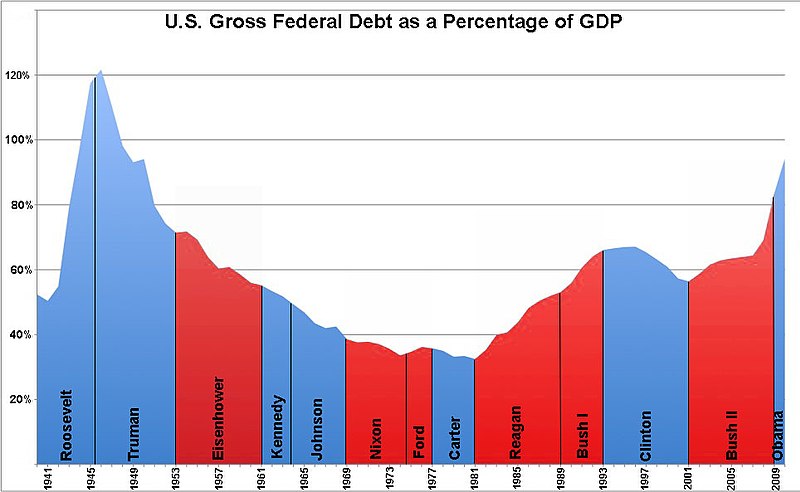
The graph above shows Federal Debt as a percent of GDP. In good times our economy should be growing enough to gradually reduce the debt as a percent of GDP. During crisis such as fighting a war, overcoming a major disaster, and fighting depressions / major recessions, we can increase the debt.


We ran up major debt to fight and win World War II. We were doing a good job of reducing that debt as a percent of GDP. We even reduced it during the Vietnam War and the War on Poverty. During the Reagan and Bush 1 administration a major build up of defense to combat Communism plus tax cuts served to increase our debt.


We did a good job of reducing our debt during the Clinton years. But we have dramatically increased our debt during Bush II and the Obama administration, partly as a cost of our two wars plus tax cuts plus fighting major recession with stimulus.


Most other countries are going through the same debt problems. Most advanced economies created good social security and health care systems. As our population ages and technology has created great new but costly medical procedures and drugs our costs have greatly increased.


We must get our costs more in line with revenues, probably with a combination of program cuts and tax increases. But we should get our economy functioning properly before we embark on a program of major cuts.


http://en.wikipedia.org/wiki/United_States_public_debt

No Silver Bullet: Paths for Reducing the Federal Debt

"America’s federal debt is as old as the nation itself, and throughout the past two centuries the debt has fluctuated dramatically, spiking during wars and economic crises and declining during times of peace and prosperity. Once again, it is on an upward climb: As a share of annual gross domestic product (GDP), it is now about three-quarters higher than what it was a decade ago, and in the next 15 years Pew projects that it will reach 95 percent of annual GDP, the highest level since 1947."

"Many economists caution that it would be unwise to attack the debt with tax increases or spending cuts while the economic downturn lingers. But nearly everybody agrees that once the economy has recovered, the nation will have to begin to control its debt or face serious economic consequences. The question is, how?"


Click to read more:


Good Lawyer Joke

As a City Planner, I enjoy a good Engineer or City Manager or lawyer joke. 


Here is one.
_________


A doctor and a lawyer were talking at a party. Their conversation was constantly interrupted by people describing their ailments and asking the doctor for free medical advice. After an hour of this, the exasperated doctor asked the lawyer, "What do you do to stop people from asking you for legal advice when you're out of the office?"

"I give it to them," replied the lawyer, "and then I send them a bill." The doctor was shocked, but agreed to give it a try. The next day, still feeling slightly guilty, the doctor prepared the bills. When he went to place them in his mailbox, he found a bill from the lawyer.


Click for more city manager jokes


Thanks to Irv Lesser for sharing.


Federal Budget and Deficit


The new Congressional Super Committee who will manage our Federal government back into relative solvency. (We Hope)

Thanks to Chris Jornlin  for sharing

New Urbanism


Can Suburbs Be Designed to Do 

Away with the Car?


The public-transit goals of "new urbanism" can fail if residents don't foresee true travel benefits


Chief Strategist


Chief Strategist for a City. Sounds like a great job. I think that is what I want to be when I grow up.


KIM WALESH
Chief Strategist
City of San Jose

Kim Walesh oversees strategic planning, partnerships, and innovations for the City of San Jose—the Capital of Silicon Valley and nation’s 10th largest city.

Read more about the Chief Strategist at:


____________________________________________________________________________


nizant

Malcolm Frank, chief strategist, Cognizant on what the future of work will look like


'The future of work is no longer in the future' says a video on the Cognizant website. Even as the world comes to terms with a reset economy, it's apparent that the same rules no longer apply. Malcolm Frank, chief strategist, Cognizant says that the world as we know it is rapidly changing, in part because of a series of events over the last few years. "As we started talking to clients during the recession to understand the situation better, we realised that this was not a cyclical shift but a secular one," he explains.

http://articles.economictimes.indiatimes.com/2011-01-14/news/28427659_1_chief-strategist-business-models-millennials


Metro Areas with High GDP


The metro area with the highest 

Japan #1 Tokyo


United States #4 Chicago
Gross Development Product in the 
world is Tokyo. It is followed by three
American metropolitan areas - 
New York, Los Angeles, and 
Chicago.


A little surprising that no
Chinese City made the top
ten metro areas. But wait
a few more years.


Click for Article


This blog was created to Plan the Planet. It is a work in progress - please click here if you wish to propose changes or additions or ask q...